

Check Sukanya Samriddhi Yojana 2026 interest rate, eligibility, deposit limits, calculator, withdrawal rules, tax benefits and maturity details.
For many families, the difficult part is not opening the account. It is understanding how Sukanya Samriddhi interest is calculated, how much can be deposited, when withdrawals are allowed, how the 21-year maturity period works, and what happens if a yearly deposit is missed.
As of the July–September 2026 quarter, the Sukanya Samriddhi Account interest rate is 8.2% per annum. The rate is notified by the Government for small-savings schemes and can change from quarter to quarter.
This guide explains the Sukanya Samriddhi Yojana interest rate, SSY calculator method, eligibility, deposit limits, withdrawal rules, maturity, tax treatment, account-opening requirements and important mistakes to avoid.
Understanding the Sukanya Samriddhi Yojana rules is important before deciding how much to contribute. The scheme has specific conditions for eligibility, deposits, interest calculation, withdrawals and maturity, so parents should understand these rules before opening an account.
Sukanya Samriddhi Yojana: Key Details at a Glance
| Feature | Details |
|---|---|
| Scheme name | Sukanya Samriddhi Account / Sukanya Samriddhi Yojana |
| Current interest rate | 8.2% p.a. for July–September 2026 |
| Intended beneficiary | Eligible girl child |
| Maximum age for opening | Before the girl turns 10 |
| Minimum annual deposit | ₹250 |
| Maximum annual deposit | ₹1,50,000 |
| Deposit period | Up to 15 years from account opening |
| Maturity | 21 years from account opening |
| Higher-education withdrawal | Up to 50%, subject to rules |
| Tax deduction | Eligible under Section 80C, subject to applicable tax rules |
| Monthly deposit compulsory? | No |
| Government-backed scheme | Yes |
The eligibility, deposit limits, maturity period and withdrawal framework are prescribed under the Sukanya Samriddhi rules and India Post’s scheme information.
What Is Sukanya Samriddhi Yojana?
Sukanya Samriddhi Yojana is a long-term savings scheme for a girl child. It was introduced as part of the government’s broader effort to encourage savings for girls and support their future financial requirements.
The account can be opened by a natural or legal guardian for an eligible girl child. The rules provide that the girl must be below 10 years of age when the account is opened. Generally, one account is permitted for each girl child, with the scheme allowing accounts for up to two girl children in a family, subject to specific exceptions provided under the rules.
Unlike an ordinary savings account, SSY is designed around a long investment horizon. Contributions can be made for the first 15 years, while the account itself matures after 21 years from the date it was opened.
What Is the Sukanya Samriddhi Interest Rate in 2026?
The Sukanya Samriddhi interest rate is 8.2% per annum for the July–September 2026 quarter.
The Government reviews small-savings interest rates periodically. The Department of Economic Affairs’ June 30, 2026 notification kept the rates unchanged for the second quarter of FY 2026–27.
This is important because you should not assume that 8.2% will remain the rate for the entire 21-year period.
The rate applicable to SSY can be revised by the Government. Therefore, online calculations that use 8.2% for every future year should be treated as illustrations rather than guaranteed maturity estimates.
Current SSY interest rate
8.2% per annum
Applicable period: July 1, 2026 to September 30, 2026.
The Sukanya Samriddhi Yojana interest rate is reviewed periodically by the Government. Therefore, the rate applicable today should not be assumed to remain unchanged throughout the account’s full maturity period.
How Is Sukanya Samriddhi Interest Calculated?
This is one of the most important things to understand before using an SSY calculator.
The scheme rules state that interest is compounded annually. The interest for a calendar month is calculated using the lowest balance in the account between the close of the 10th day and the end of that month. The interest is credited to the account at the end of the financial year.
Why does the deposit date matter?
Suppose you are planning to deposit money into your daughter’s SSY account.
If the money is deposited early enough in the month, it can be considered for the applicable monthly interest calculation. A deposit made after the relevant date may not receive the same month’s interest calculation.
For this reason, people often prefer making their annual or monthly contribution before the 10th of the month rather than leaving it until later.
The exact calculation follows the scheme rules, not a simple fixed-interest formula.
Sukanya Samriddhi Calculator: How to Calculate Maturity Amount
A Sukanya Samriddhi calculator generally requires information such as:
- Girl child’s age
- Account opening date
- Annual or monthly contribution
- Contribution period
- Applicable interest rate
- Expected maturity date
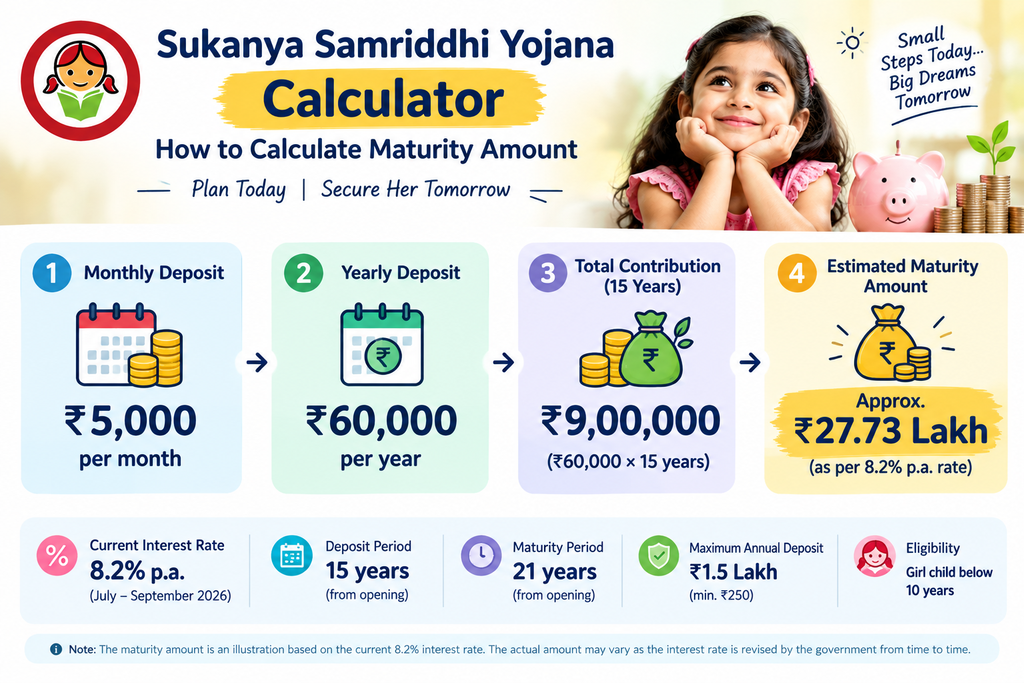
However, there is an important limitation.
| Monthly Deposit | Annual Deposit | Total Deposits for 15 Years |
|---|---|---|
| ₹1,000 | ₹12,000 | ₹1,80,000 |
| ₹2,500 | ₹30,000 | ₹4,50,000 |
| ₹5,000 | ₹60,000 | ₹9,00,000 |
| ₹10,000 | ₹1,20,000 | ₹18,00,000 |
| ₹12,500 | ₹1,50,000 | ₹22,50,000 |
Important: Contribution Amount vs Maturity Amount
The table above shows the total amount deposited over 15 years, not the final maturity amount.
For example, if you deposit ₹5,000 every month:
₹5,000 × 12 months = ₹60,000 per year
₹60,000 × 15 years = ₹9,00,000 total contribution
The final maturity value can be higher because interest is credited to the account according to the applicable Sukanya Samriddhi rules. However, the future interest rate can change, so a calculator using today’s 8.2% rate for all future years should be treated only as an illustration.
However, there is an important limitation: an SSY calculator cannot guarantee the final maturity amount because the interest rate may change during the account’s 21-year maturity period.
If a calculator assumes that the current 8.2% interest rate remains unchanged for the entire investment period, the result should be treated as an illustrative estimate, not a guaranteed maturity amount.
For better planning, separate these two figures:
- Current SSY interest rate: 8.2% per annum for July–September 2026
- Projected long-term return: Depends on the interest rates notified by the Government in future periods.
What Information Does an SSY Calculator Need?
An SSY calculator generally uses the following information:
- Girl child’s age
- Account opening date
- Monthly or annual contribution
- Contribution period
- Applicable interest rate
- Expected maturity period
The calculator then estimates the possible value of the account based on the assumptions entered.
SSY Contribution Example
Suppose you deposit ₹5,000 per month for 15 years:
₹5,000 × 12 × 15 = ₹9,00,000
So, your total contribution over 15 years would be ₹9 lakh.
The account can then continue until the 21-year maturity period from the date of opening, with interest credited according to the applicable SSY rules.
The final amount will depend on the interest rates applicable during the relevant periods. Therefore, use an SSY calculator to understand possible outcomes rather than treating one calculated figure as a guaranteed return.
Sukanya Samriddhi Calculator Example
India Post publishes illustrative maturity calculations for SSY based on the applicable rate. For example, an illustrative table using an 8.2% rate shows that a ₹5,000 monthly contribution for 15 years corresponds to total deposits of ₹9 lakh and an illustrative maturity value of approximately ₹27.73 lakh after 21 years under the assumptions used in that table.
The important point is not to treat ₹27.73 lakh as a guaranteed future amount.
Instead, understand the structure:
Monthly contribution × 12 × 15 years = total contribution
The account then continues until the 21-year maturity period is completed, with interest credited according to the applicable government-notified rate.
How Much Can You Deposit in Sukanya Samriddhi Yojana?
The current rules allow:
Minimum deposit
₹250 per financial year
Maximum deposit
₹1,50,000 per financial year
Monthly contributions are not compulsory. You can choose a contribution schedule that suits your finances, provided the applicable annual minimum is maintained. India Post specifically notes that monthly deposits are not mandatory.
Example
You could contribute:
- ₹250 per year
- ₹1,000 per month
- ₹2,500 per month
- ₹5,000 per month
- ₹10,000 per month
- ₹12,500 per month
A ₹12,500 monthly contribution equals:
₹12,500 × 12 = ₹1,50,000 per year
That reaches the annual deposit ceiling.
For How Many Years Do You Need to Deposit Money?
This is another area where people often confuse deposit period with maturity period.
They are not the same.
Deposit period
You can make deposits for 15 years from the date the account is opened.
Maturity period
The account matures 21 years from the date of opening.
Simple example
Suppose an SSY account is opened when the girl is 5 years old.
- Age 5: Account opened
- Age 5–20: Deposits can be made during the applicable 15-year contribution period
- Age 26: Account reaches 21 years from opening
This is why SSY should be viewed as a long-term financial planning instrument, rather than a short-term savings account.
Sukanya Samriddhi Yojana Eligibility
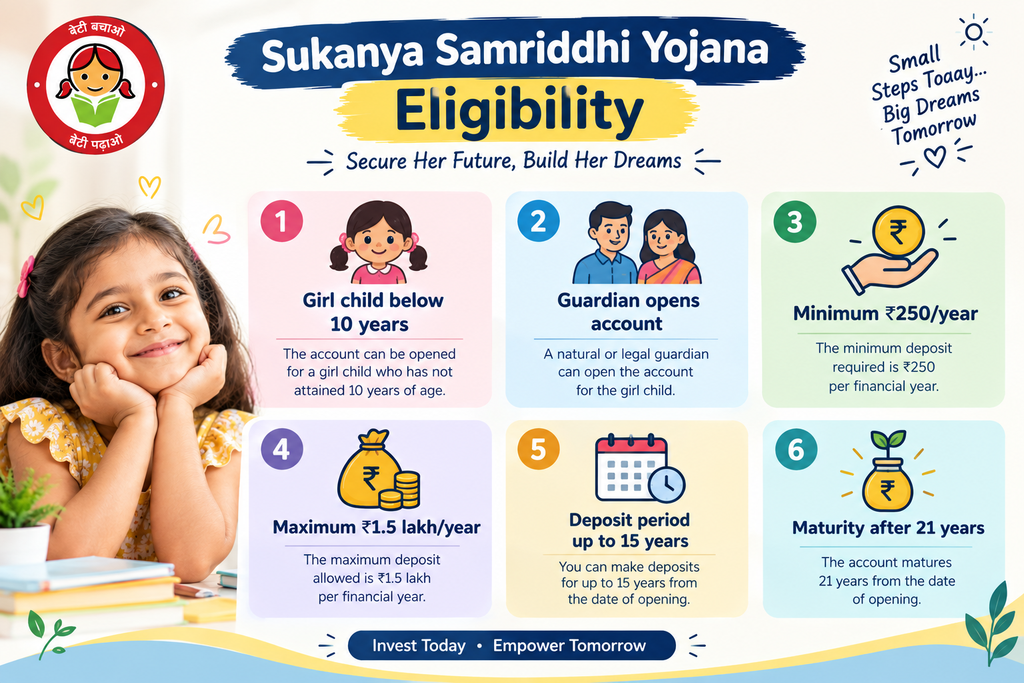
The basic eligibility conditions include:
1. The account is for a girl child
The account is opened in the name of the eligible girl child.
2. The girl must be below 10 years old
The rules specify that the account may be opened for a girl who has not attained the age of 10 years on the date of opening.
3. Guardian can open the account
A natural or legal guardian can open the account for the eligible girl child.
4. One account per girl child
Only one SSY account can generally be opened in the name of each girl child.
5. Family limit
Normally, the scheme permits accounts for a maximum of two girl children in a family, subject to the exceptions specified in the rules for certain multiple births and related circumstances.
The Sukanya Samriddhi Yojana eligibility rules mainly relate to the age of the girl child, the role of the guardian and the number of accounts permitted within a family.
What Documents Are Required for Sukanya Samriddhi Yojana?
When opening an SSY account, documents generally include:
- Girl child’s birth certificate
- Guardian’s identity proof
- Guardian’s address/residence proof
- KYC documents
- Account-opening form
- Other documents required by the bank or post office
The scheme rules specifically require the girl’s birth certificate along with identity and residence-related documents of the guardian.
Because documentation requirements and KYC processes can be updated, it is sensible to confirm the current checklist with the relevant post office or authorised bank before visiting.
Where Can You Open a Sukanya Samriddhi Account?
An SSY account can be opened through authorised post offices and eligible banks.
India Post provides Sukanya Samriddhi Account services through its network, and the scheme rules recognise authorised banking channels for opening the account.
Sukanya Samriddhi Withdrawal Rules
SSY is not designed for unrestricted withdrawals.
A partial withdrawal can be made for higher education, subject to the conditions specified under the rules.
The rules allow withdrawal of up to 50% of the balance for higher education, calculated with reference to the balance at the end of the financial year preceding the year of application. The account holder must have attained 18 years of age or passed the 10th standard, whichever is earlier, and documentary evidence relating to admission/fees is required.
Important point
The 50% figure does not mean that you can automatically withdraw half of whatever balance you see on the day you apply.
The applicable calculation is linked to the balance at the end of the preceding financial year and the specific education-related conditions.
The tax treatment of Sukanya Samriddhi Yojana contributions and account proceeds should be considered along with the applicable income-tax rules for the relevant financial year.
Can You Withdraw Sukanya Samriddhi Money for Education?
Yes, subject to the scheme’s withdrawal conditions.
The withdrawal is intended for higher education of the account holder.
The rules provide that the amount can be withdrawn as a lump sum or in instalments, subject to the prescribed conditions and ceiling. The withdrawal is also restricted to the actual financial requirement supported by admission documentation or fee-related evidence.
Can Sukanya Samriddhi Be Closed Before 21 Years?
Yes, but only under specified circumstances.
One important situation is the girl’s marriage after she reaches the required age.
The rules provide for premature closure in connection with the intended marriage of the account holder, subject to the prescribed age and timing conditions.
Therefore, it is incorrect to describe SSY as an account that can simply be closed whenever the depositor wants.
What Happens When Sukanya Samriddhi Account Matures?
An SSY account generally matures 21 years from the date of opening.
At maturity, the balance along with the interest standing to the credit of the account becomes payable to the account holder, subject to the applicable closure and documentation requirements.
The scheme rules also state that interest is not payable once the account completes the 21-year period from opening.
What Happens If You Miss the Minimum Annual Deposit?
This is an important rule for parents who choose SSY.
A minimum annual contribution of ₹250 is required.
If the required minimum is not deposited, the account can be treated as being in default.
The rules provide a mechanism for regularising a default by paying the required minimum deposit for the defaulted year or years along with a ₹50 penalty for each year of default, subject to the applicable rules.
So missing a year’s deposit does not necessarily mean the account is permanently lost.
However, the default should be regularised rather than ignored.
Is Monthly Deposit Mandatory in Sukanya Samriddhi?
No.
This is one of the easiest SSY rules to misunderstand.
You do not have to deposit money every month.
You need to satisfy the applicable minimum annual deposit requirement.
For example, instead of depositing ₹500 every month, a family could structure contributions differently during the financial year, as long as the applicable scheme rules are followed.
India Post explicitly states that monthly deposits are not compulsory.
Sukanya Samriddhi Tax Benefits
SSY contributions qualify for tax benefits under Section 80C, subject to the applicable provisions of the Income Tax Act.
The Income Tax Department lists Section 80C within the deductions available under the old tax regime, with the combined Section 80C/80CCC/80CCD(1) limit generally being ₹1.5 lakh.
Important tax point
Do not assume that simply depositing ₹1.5 lakh into SSY automatically gives you an additional ₹1.5 lakh deduction on top of every other Section 80C investment.
The overall applicable deduction limit and the tax regime you use matter.
For tax planning, check the rules applicable to the relevant assessment year.
Is Sukanya Samriddhi Interest Taxable?
SSY is commonly described as having an EEE-style tax treatment, but tax treatment should always be considered under the tax law applicable to the relevant year.
The key point for a reader is that SSY has tax benefits associated with eligible contributions and its interest/maturity treatment, but tax planning should not be based solely on the headline interest rate.
Your tax regime, Section 80C eligibility and applicable income-tax rules should be considered separately.
Sukanya Samriddhi vs Fixed Deposit
People often compare SSY with bank fixed deposits.
The two products work differently.
| Feature | Sukanya Samriddhi | Fixed Deposit |
|---|---|---|
| Target | Girl-child long-term savings | General savings/investment |
| Current SSY rate | 8.2% for Jul–Sep 2026 | Depends on bank/tenure |
| Deposit flexibility | Annual contribution rules apply | Depends on FD |
| Maturity | 21 years from opening | Usually fixed tenure |
| Partial withdrawal | Restricted | Depends on FD terms |
| Government scheme | Yes | Bank deposit |
| Tax treatment | Specific SSY/Income Tax rules | Depends on FD type and taxpayer |
| Long-term purpose | Girl child’s future needs | General financial goals |
The most important difference is that SSY is purpose-specific and long-term, whereas an FD can be structured around a much wider range of financial goals.
Sukanya Samriddhi vs PPF
SSY and PPF are both government-backed small-savings products, but their structures are different.
| Feature | SSY | PPF |
|---|---|---|
| Main beneficiary | Eligible girl child | Individual |
| Current rate Jul–Sep 2026 | 8.2% | 7.1% |
| Maximum annual contribution | ₹1.5 lakh | ₹1.5 lakh |
| SSY maturity | 21 years from opening | 15 years, subject to PPF rules |
| Purpose | Girl child’s future | General long-term savings |
| Early withdrawal | Restricted and purpose-based | Subject to PPF rules |
The rates shown above are the notified rates for the July–September 2026 quarter.
Common Sukanya Samriddhi Mistakes to Avoid
1. Assuming 8.2% is guaranteed for 21 years
It isn’t.
The Government can revise small-savings rates.
Use 8.2% as the current applicable rate, not as a guaranteed 21-year rate.
2. Confusing 15 years with 21 years
You contribute for up to 15 years, but the account matures after 21 years from opening.
3. Thinking monthly deposits are mandatory
They aren’t.
The requirement is based on the annual minimum contribution.
4. Depositing after the 10th without understanding the interest calculation
The scheme calculates monthly interest based on the lowest balance between the close of the 10th and the end of the month.
Therefore, contribution timing can affect the interest calculation.
5. Treating the account like a normal savings account
SSY has specific withdrawal and closure conditions.
It isn’t designed for frequent withdrawals.
6. Ignoring a missed annual contribution
A default can have consequences, but the scheme provides a mechanism for regularisation subject to the prescribed penalty and rules.
How to Maximise the Benefit of Sukanya Samriddhi
There is no guaranteed way to “maximise returns” because the future interest rate is not fixed for 21 years.
However, parents can manage the account efficiently by:
Start early
Opening the account when the child is eligible gives the savings more time to compound.
Contribute consistently
Regular contributions can make long-term saving easier to manage.
Watch the annual ceiling
The maximum annual contribution is ₹1.5 lakh.
Consider contribution timing
Because of the scheme’s monthly interest calculation, understanding the 10th-day rule can help you plan deposits more effectively.
Don’t treat the current rate as permanent
Review the officially notified interest rate when making long-term projections.
Sukanya Samriddhi Yojana: Frequently Asked Questions
What is the current Sukanya Samriddhi interest rate?
The SSY interest rate is 8.2% per annum for July–September 2026. The Government reviews small-savings rates periodically, so future quarters may have different rates.
What is the minimum deposit in Sukanya Samriddhi?
The minimum required deposit is ₹250 in a financial year.
What is the maximum SSY deposit per year?
The maximum permitted annual deposit is ₹1.5 lakh.
Can I deposit ₹1 lakh in Sukanya Samriddhi?
Yes. The annual maximum is ₹1.5 lakh, so ₹1 lakh falls within the permitted annual limit, subject to the scheme’s rules.
Can I deposit more than ₹1.5 lakh?
The annual deposit ceiling is ₹1.5 lakh. Amounts deposited beyond the prescribed annual ceiling do not qualify for interest under the scheme rules.
Is monthly deposit compulsory?
No. India Post states that monthly deposits are not compulsory.
What is the maturity period of Sukanya Samriddhi?
The account generally matures 21 years from the date it was opened.
For how many years do I have to deposit money?
Deposits can be made for up to 15 years from the date of account opening.
Can I withdraw money from SSY?
Yes, but withdrawals are restricted. Up to 50% may be withdrawn for higher education subject to the eligibility, documentation and calculation requirements under the scheme rules.
Can SSY be closed before maturity?
Premature closure is permitted only in specified circumstances, including the prescribed conditions relating to the girl’s marriage after the required age.
What happens if I miss an SSY payment?
The account may be treated as being in default. The rules provide for regularisation through payment of the required minimum amount plus the applicable ₹50-per-year penalty.
Who can open a Sukanya Samriddhi account?
A natural or legal guardian can open the account for an eligible girl child who has not attained 10 years of age on the date of opening.
Can I open two Sukanya Samriddhi accounts for two daughters?
The scheme generally permits accounts for up to two girl children in a family, with specific exceptions in the rules for certain multiple-birth situations.
Is Sukanya Samriddhi eligible for tax deduction?
Eligible contributions qualify under Section 80C, subject to the applicable tax rules and limits.
Is Sukanya Samriddhi better than an FD?
That depends on the financial goal, liquidity requirement, tax situation, time horizon and the interest rate available on the alternative. SSY has specific eligibility and withdrawal restrictions, while an FD has different terms.
Sukanya Samriddhi Yojana: Important Rules Checklist
Before opening or contributing to an account, remember these points:
- Girl child must generally be below 10 years when the account is opened.
- Guardian opens the account.
- Minimum annual deposit: ₹250.
- Maximum annual deposit: ₹1.5 lakh.
- Monthly deposits are not compulsory.
- Deposits can be made for up to 15 years from opening.
- Maturity is 21 years from opening.
- Current interest rate: 8.2% for July–September 2026.
- Interest is compounded annually.
- Monthly interest calculation considers the lowest balance during the specified period of the month.
- Higher-education withdrawal is permitted subject to specific rules.
- Premature marriage-related closure has specific conditions.
- Missed annual deposits can result in default and require regularisation.
- Section 80C tax benefits are subject to the applicable tax regime and statutory limits.
Before opening a Sukanya Samriddhi Yojana account, compare the contribution requirement, investment period, withdrawal restrictions and applicable tax rules with your family’s financial goals.
Final Takeaway
Sukanya Samriddhi Yojana is a long-term savings account specifically structured around the financial future of an eligible girl child.
For the July–September 2026 quarter, the applicable interest rate is 8.2% per annum. The scheme allows deposits from ₹250 up to ₹1.5 lakh in a financial year, contributions for up to 15 years, and maturity 21 years after account opening. Withdrawals are restricted and can be made for higher education under prescribed conditions.
The biggest point to remember is that today’s 8.2% rate should not be treated as a guaranteed rate for the entire 21-year period. When using an SSY calculator, check which interest rate and assumptions the calculator uses.
For families considering this scheme, the most useful approach is to look at eligibility, contribution capacity, time horizon, liquidity needs and tax rules together, rather than choosing the scheme based only on the headline interest rate.
Official and Verified Sources
For credibility and E-E-A-T, you can add a “Verified Sources” section at the bottom of the article. These are the sources I checked while preparing the article:
- Department of Economic Affairs — Sukanya Samriddhi Account
- Department of Economic Affairs — Small Savings Schemes / Interest Rate Notifications
- Sukanya Samriddhi Account Rules — Government of India
- India Post — Sukanya Samriddhi Account information
- India Post — Small Savings Schemes information
- Income Tax Department — Tax deductions and Section 80C information